
We all hate punctures, especially when we’re on 2-wheels – at least most cars carry a space saver in the boot.
With that in mind a team of scientists at the Harvard John A. Paulson School of Engineering and Applied Sciences (SEAS) have been working hard to develop a new kind of hybrid rubber which can self-heal.
The SEAS researchers have already created self-healing materials that rely on water, but creating this kind of self-healing technology in so called ‘dry materials’ such as rubber is a far greater challenge.
Rubber compounds consist of polymers, and these are often connected by strong covalent bonds. These covalent bonds are incredibly strong, but once they’ve been broken they will never reconnect. SEAS scientists have since been looking at ways to make these connecting bonds reversible, so that they could break and reform – therefore making the rubber self-healable.
The only problem with a reversible bond is that it is often far weaker than a covalent bond, so not ideal for use on something like a tyre, which is subjected to extreme forces.
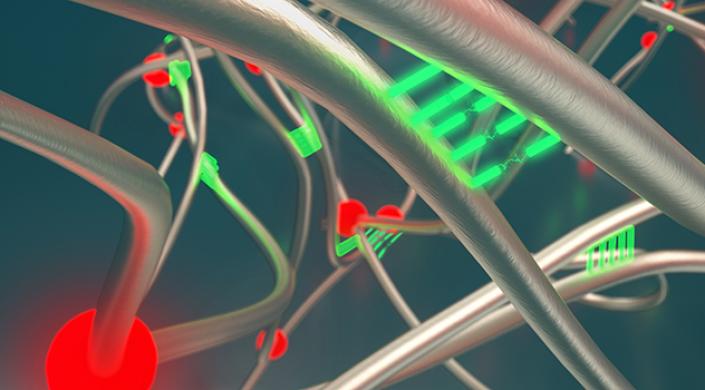
Li-Heng Cai, Jinrong Wu and David A Weitz have now developed a hybrid rubber which uses both covalent and reversible bonds. In the image above, the covalent bonds are shown in red, and the reversible bonds in green.
One major potential stumbling block was getting the two tyres of bonds to mix – they simply don’t like to.
Therefore the researchers developed a molecular rope called ‘Randomly Branched Polymers’ which can tie reversible and covalent bonds together. This has helped to create a rubber that is both tough and self-healing.
Rubber typically tends to crack once it reaches a certain stress point. However, when the new hybrid rubber is stretched it develops ‘crazes’ – they’re similar to cracks, but are connected by fibrous strands. They help to redistribute the stress across the tyre, so that there is no single point of stress which could lead to a catastrophic failure of the tyre.
Once it releases that stress, the hybrid rubber returns to its original form and the crazes are healed.
Harvard’s Office of Technology Development is already busy filing a patent application for the technology, and as you can imagine they are actively seeking opportunities to bring the product to market.
“Imagine that we could use this material as one of the components to make a rubber tyre,” said Wu. “If you have a cut through the tyre, this tyre wouldn’t have to be replaced right away. Instead, it would self-heal while driving enough to give you leeway to avoid dramatic damage.”
“There is still a lot more to do,” added Weitz. “For materials science, it is not fully understood why this hybrid rubber exhibits crazes when stretched. For engineering, the applications of the hybrid rubber that take advantage of its exceptional combination of optical transparency, toughness, and self-healing ability remain to be explored. Moreover, the concept of using molecular design to mix covalent and reversible bonds to create a homogenous hybrid elastomer is quite general and should enable development of tough, self-healing polymers of practical usage.”
It may be many years before we see something like this come to market on either 2 or 4-wheels, but imagine the possibilities!

