

Following last week’s launch of the Michelin Power RS to both dealers and the press, reviews have been starting to pop up across the globe, and the latest is from America’s much respected Motorcycle.com team.
Michelin’s engineers have worked hard to deliver some big improvements in performance over the Pilot Power 3 in areas such as outright dry grip, handling response and stability.
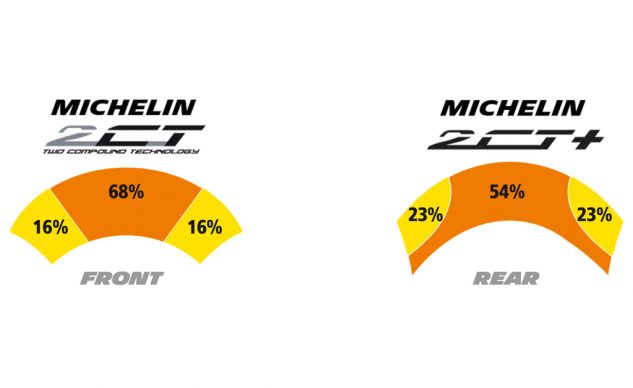
As an improvement to their existing 2CT technology, Michelin have used a new 2CT+ compound layout on the rear tyre which sees a layer of the more wear resistant central compound also sit underneath the softer shoulder compound, increasing sidewall stiffness.
The front tyre uses the standard 2CT technology, as do the H-rated rear sizes for smaller capacity sports bikes such as KTM’s RC390 which simply don’t need this kind of technology.
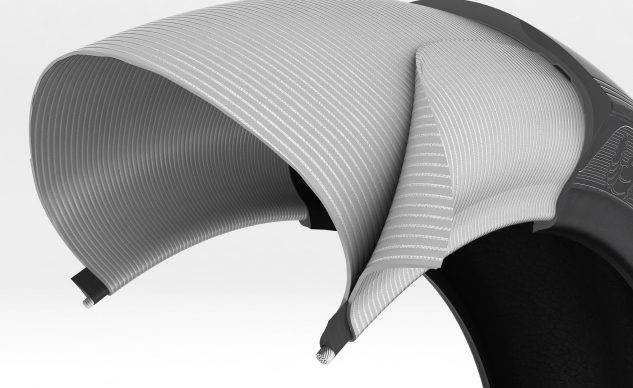
Michelin have also used ACT+ technology to create a softer crown area without affecting sidewall stiffness, further enhancing stability at all angles of lean. The tyre’s 90-degree belt is wrapped around the bead as shown in the image above to double the layering across selected areas of the profile. This helps the tyre to better handle the forces of acceleration when the bike is leaned over and exiting a corner.
But how has this improved performance over the Pilot Power 3 in real terms?

Motorcycle.com say:
“As early as the first corner of the second session, where we got our initial sampling of the Power RS, one change was immediately noticeable. Where the Pilot Power 3 tended to fall into corners, the Power RS preferred to be bent in at the entry. This is not to say that the steering was slow. Rather, part of the tyre’s agility goal is the precision with which the rider can steer. So, at the entry, the rider, not the front tyre profile, determined the line at corner entry.
This ease of managing lines carried over to mid-corner, as well. On the track, the need to alter lines is usually necessitated by passing or being passed by other riders. Regardless of the cause, the Power RS tyres willingly changed lines, allowing me to precisely dial in the amount of lean desired from the motorcycle.
Stability was another of the stated design goals, and the Power RS rear tyre was unflappable as the S1000RR rocketed down Losail’s long front straight with the throttle turned to the stop. As the night wore on, I frequently saw top speeds in the 170-mph range before I popped out from behind the bubble to brake for Turn 1. Here another form of stability was demonstrated. When hard on the front brake, the S1000RR’s line remained rock-steady with nary a waggle of the bar. Although I’m hardly a demon on the brakes, on a couple instances, traffic I encountered in this braking zone caused me to ramp up my braking much quicker than I typically would if left to my own preferred corner entry. In these instances, the Power RS tyres remained steady.”
Many of the key sizes are already available to the UK trade from Cambrian Tyres, with more stocks due in the near future.
You can ready the full review at Motorcycle.com.
Check out the range of Power RS sizes here.

