
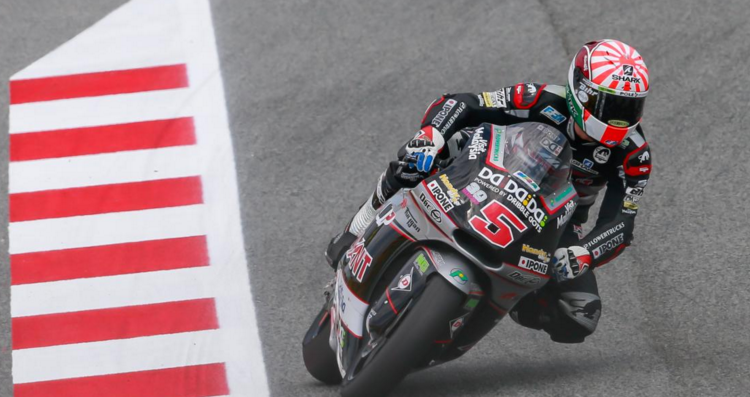
Dunlop have been the sole supplier to the Moto2 and Moto3 series for several years now, and during that time their tyres have undergone constant development to help improve consistency and performance.
But how do Dunlop develop their Moto2 rubber?
Well, the life of any Moto2 tyre starts outs as a computer model. Dunlop use advanced computer simulation to predict properties such as camber thrust and spring rate, then calculates the effects of introducing alternative materials to the tyre, and then finds the optimum profile. This can take anything up to a week before the process is finished.
From here, Dunlop engineers construct 3D models using CAD software in order to visualise the intended tyre. A process known as Finite Element Analysis will depict any high load areas on the tyre that could generate excessive heat. Only when all the computer work is done do Dunlop then cut the metal for the tyre moulds.
The first part of the build is the tyre carcass, and in this case it consists of fine layers of specialist materials such as metallic fibres, along with regular materials like polyamide and rayon. This forms the basis of Dunlop’s NTEC system, which means that tyres can be run at lower pressures to give improved sidegrip, durability, traction and feedback – a feature present in some of Dunlop’s race rubber available to the retail public for race and trackday use.
Dunlop pioneered their Multi-Tread system in the early ’80s, giving a harder wearing centre compound and a softer rubber on the shoulder for increased grip in the corners. However, their race tyres take this much further. Their engineers have collated laser scans of each major circuit, allowing them to categorise tracks based on their severity. This information, along with data from past races and tests, allow them to more accurately predict which compound will be best suited to each track.
The latest manufacturing technology within their motorsport division will allow them to fine tune a tyre for a particular corner, by adding the finest sliver of a particular compound to a specific point on the tyre with pin-point accuracy.
The tyres used in Moto2 must offer consistent performance over a wide range of operating conditions, so stringent quality control procedures are in place both before and after the manufacturing process is completed. The finished tyre is then x-rayed to check for uniformity and balance.
The lessons learned on the race track are often then applied across their motorcycle range, bringing many of these benefits to riders just like you.
Check out the Dunlop motorcycle and scooter tyre range here.

