
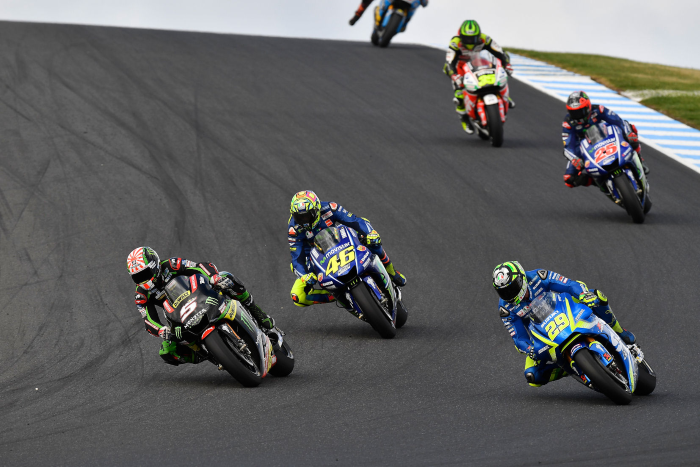
Working towards their return to MotoGP in 2016, Michelin relied on their experience in both World Endurance and national championships when developing tyres for the series. During that inaugural season Michelin claimed to have engineered more developments than during the previous seven years of working in other motorcycle racing disciplines. A year on in Qatar at the start of the 2017 season, Michelin already had a season as sole tyre supplier behind the, and as such their focus then shifted to building upon these developments.
“Each race gives us more data to take forward as the project advances, therefore in 2017 we made a conscious decision to consolidate the development of our tyres,” shares Piero Taramasso, manager of two-wheel motorsport for Michelin. A new front tyre construction was introduced, along with what Taramasso calls a “consistent construction” for the rear, and these were then matched with compounds specific to the demands of each circuit.
Taramasso states that no major changes were made to either the Power Slick or Power Rain this year, with the development approach being more along an evolutionary line. Data taken from the 2016 season allowed Michelin to fine tune their compounds to specific tracks, and they plan to refine this further in 2018.
This approach clearly works for Dorna, who back in October confirmed the tyre maker’s status as official supplier of to the end of the 2023 season.
“The new rule instigated at the start of 2017 – with three front and three rear slick tyres available for all riders – worked very well, and Dorna has been pleased with the way we have responded to the challenge and with the tyres we have supplied,” Taramasso elaborates. “Michelin already had a three-year agreement in place with the option to extend and that has been taken, so we will now be the official tyre supplier to MotoGP until at least 2023.”
The season has not been without controversy however. In the opening round Valentino Rossi complained that the 2017 front tyre had slowed him down. Two weeks later and Michelin unexpectedly provided an additional front tyre in Argentina, with accusations that this previously retired option had been brought specifically for the veteran Italian rider.
In the end, the additional tyre didn’t end up being used in Argentina, although riders eventually voted for it to replace the less rigid ‘06’ front tyre later in the season. Michelin vehemently denied any kind of favouritism, with Taramasso stating that “With the three front and three rear solutions, all manufacturers can find the best solution for their teams and riders. This has been seen throughout the season with many different combinations being used successfully on different machines.”
Bridgestone used their many years as sole supplier in the series to filter tech down from MotoGP to their publicly available road and track tyres, and Taramasso confirms that Michelin has already started supplying commercially available race rubber that benefits from information gathered in MotoGP.
The switch from 16.5″ to 17″ tyres in 2016 will also aid the transition of MotoGP derived technology to the tyres you’ll find in your local dealer in the coming years.

